 ×

The ferrite core coil represents a critical component in modern RF and power electronics applications, but its performance characteristics change dramatically as operating frequencies increase. Understanding these limitations is essential for engineers designing circuits that operate beyond standard frequency ranges. A ferrite core coil exhibits specific saturation points, core loss characteristics, and impedance behaviors that directly constrain maximum operating frequency and power handling capacity.
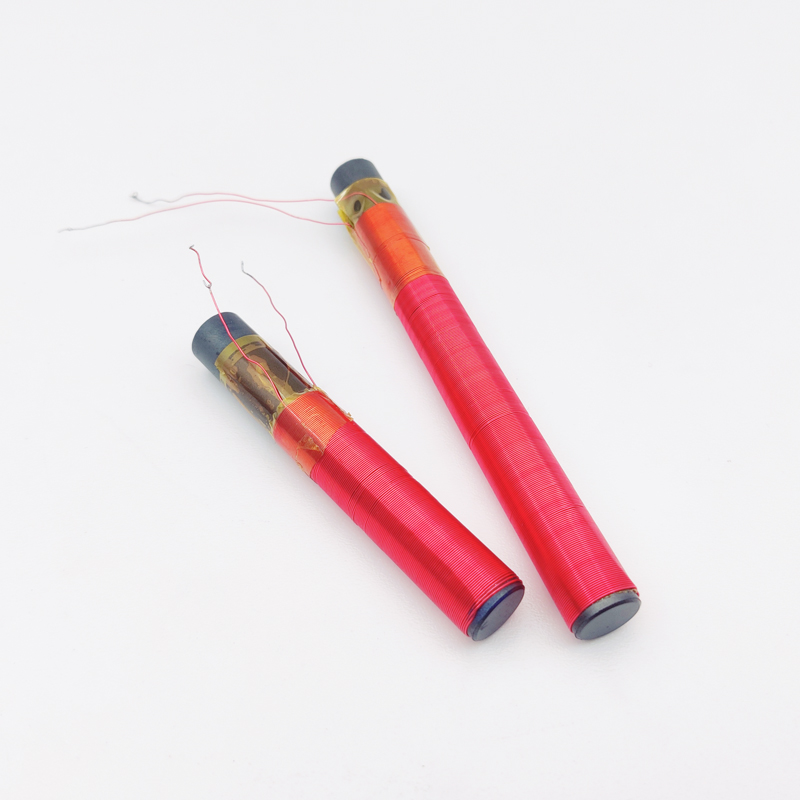
This article explores the practical performance boundaries of ferrite core coil designs at elevated frequencies, examining the physical mechanisms that create these limits and the trade-offs engineers must navigate. By understanding core saturation, dielectric losses, skin effect interactions, and impedance resonance, designers can optimize ferrite core coil selections for specific frequency bands and power levels.
Saturation occurs when a ferrite core coil reaches its maximum magnetic flux density, beyond which increasing current produces no additional inductance gain. The saturation point of a ferrite core coil depends on material composition, typically ranging from 250 to 500 millitesla for standard ferrite formulations. When a ferrite core coil saturates, its permeability collapses, inductance drops sharply, and the component transforms into a resistor, generating heat rather than storing magnetic energy effectively.
At high frequencies, the ferrite core coil experiences rapid magnetic field reversals, requiring the material to cycle between positive and negative saturation states many times per microsecond. This cycling stress accelerates saturation effects and increases core losses exponentially. Different ferrite core coil materials respond differently to frequency stress; MnZn ferrites saturate at lower frequencies than NiZn ferrites, making material selection critical for high-frequency applications where a ferrite core coil must maintain stable inductance.
The inductance of a ferrite core coil decreases nonlinearly as DC or AC current increases toward saturation levels. This phenomenon, called 'inductance droop,' becomes more pronounced at higher operating frequencies where a ferrite core coil has less time to recover magnetic orientation between field reversals. Engineers must derate the useful current capacity of a ferrite core coil significantly when frequency increases, sometimes reducing allowable current to 50 percent or less compared to low-frequency operation.
Measuring the actual performance of a ferrite core coil requires testing under the exact frequency and current conditions of the intended application, not relying solely on datasheet values listed at 1 kilohertz. A ferrite core coil rated for 10 amperes at 100 kilohertz might safely handle only 3 or 4 amperes at 1 megahertz before saturation induced inductance collapse becomes problematic.
Core loss in a ferrite core coil comprises two primary mechanisms: hysteresis loss and eddy current loss. Hysteresis loss represents the energy dissipated during each magnetic cycle as domains resist directional changes, while eddy current loss arises from circular current paths induced within the ferrite material itself. For a ferrite core coil, hysteresis loss typically dominates at frequencies below 1 megahertz, but eddy current losses accelerate dramatically above this threshold, increasing proportionally to the square of frequency.
This rapid escalation of core loss means that a ferrite core coil operating at 10 megahertz experiences roughly 100 times more eddy current loss than the same component at 1 megahertz. The ferrite core coil begins radiating this energy as heat, raising junction temperature and potentially triggering thermal runaway or component failure. Designers must account for this nonlinear loss behavior when selecting a ferrite core coil for high-frequency power applications, often oversizing the core or adding active cooling.
Most ferrite materials used in a ferrite core coil exhibit negative temperature coefficients, meaning permeability and inductance decrease as temperature rises. This creates a feedback loop at high frequencies: increased losses raise component temperature, elevated temperature reduces inductance, and reduced inductance increases current to maintain flux, generating even more losses. A ferrite core coil can enter thermal collapse if the operating point exceeds the material's Curie temperature, the point above which ferrite loses permanent magnetic ordering.
The practical performance limit of a ferrite core coil therefore combines frequency-dependent loss, current-dependent saturation, and temperature sensitivity into a complex constraint surface. A ferrite core coil suitable for reliable operation must remain below all three limits simultaneously, a requirement that becomes increasingly difficult as frequency climbs above 5 megahertz.
Every practical ferrite core coil possesses distributed capacitance between wire turns and between turns and the core structure. This parasitic capacitance combines with the ferrite core coil inductance to form a resonant circuit, creating a self-resonant frequency above which the component transitions from inductive to capacitive behavior. The ferrite core coil's impedance peaks at its self-resonant frequency, then drops rapidly, severely limiting useful frequency range.
For large ferrite core coil designs with many turns, self-resonance can occur in the low-megahertz range, far below the highest frequency at which individual ferrite core coil materials remain magnetically stable. A ferrite core coil wound on a toroidal core with 200 turns might self-resonate at 3 megahertz, making it unsuitable for reliable operation above that point regardless of material composition. High-frequency applications often require ferrite core coil designs with fewer turns and higher impedance to push self-resonance well above the operating frequency band.
At high frequencies, current distribution within the copper wire of a ferrite core coil becomes nonuniform due to skin effect, where electromagnetic forces concentrate current flow near the wire surface. Skin depth in copper decreases with rising frequency, causing effective resistance of the ferrite core coil windings to increase dramatically. A ferrite core coil at 1 kilohertz exhibits only DC copper resistance, but the same component at 10 megahertz experiences 20 to 50 times higher winding resistance due to skin effect concentration.
This winding resistance increase directly translates to additional core losses and reduced Q-factor for the ferrite core coil, further limiting power handling and efficiency. The ferrite core coil design must therefore account for skin effect by using appropriate wire gauge, litz wire construction, or planar winding geometries to mitigate resistance growth at target frequencies.
Engineers selecting a ferrite core coil material must balance saturation characteristics, temperature stability, and loss profiles against the intended frequency range. MnZn ferrite materials provide excellent permeability and low-frequency performance but saturate at lower frequencies and generate higher eddy current losses above 5 megahertz. NiZn ferrites offer superior high-frequency characteristics, lower saturation flux density, and acceptable losses up to 100 megahertz or higher, making NiZn ferrite core coil designs the standard choice for RF and high-frequency switched-mode power supplies.
The choice between ferrite core coil materials directly determines usable frequency ceiling. A ferrite core coil wound on MnZn material and rated for operation to 1 megahertz cannot simply be rewound with NiZn ferrite to achieve 10 megahertz performance; the entire design geometry must be reconsidered to optimize for the new frequency band and material properties.
Reducing ferrite core coil size and turn count pushes self-resonant frequency higher and reduces distributed capacitance, enabling operation at higher frequencies. However, smaller cores have lower saturation flux density in absolute terms and reduced surface area for heat dissipation, creating competing constraints. Optimal ferrite core coil design requires careful balancing between core volume, winding count, wire gauge, and frequency target to achieve acceptable performance within thermal and saturation margins.
At extremely high frequencies above 50 megahertz, traditional ferrite core coil designs often prove impractical, and alternative topologies such as chip inductors or distributed circuit elements may offer superior performance with fewer parasitic effects limiting ferrite core coil utility.
Performance degradation in a ferrite core coil typically becomes noticeable around 1 to 5 megahertz, depending on material type, core size, and winding design. MnZn ferrite core coil materials exhibit more pronounced losses starting near 1 megahertz, while NiZn ferrite core coil designs can operate acceptably to 50 megahertz or higher. The specific degradation point for any given ferrite core coil requires empirical measurement under actual operating conditions rather than relying on low-frequency datasheet specifications.
Yes, a ferrite core coil can operate reliably in megahertz-range applications when designed specifically for high-frequency operation using NiZn ferrite material, optimized core geometry, minimal turn count, and appropriate wire sizing. However, the ferrite core coil's current capacity, power handling, and inductance stability degrade significantly compared to low-frequency operation. Careful thermal management and conservative derating of published specifications are mandatory when using a ferrite core coil above 5 megahertz.
Temperature significantly impacts ferrite core coil performance at high frequencies through negative temperature coefficients that reduce permeability and inductance as temperature rises. Elevated temperature also reduces the saturation flux density of the ferrite core coil material and increases core losses, creating a feedback loop where losses generate heat that further degrades performance. A ferrite core coil operating near thermal limits can experience rapid performance collapse if ambient temperature or load conditions increase unexpectedly.
 Hot News
2026-10-15
2026-10-13
2026-10-08
2026-10-06
2026-10-01
2026-09-21
Zhongshan Landa Technology: ISO9001 & UL-certified manufacturer of custom electromagnets, push-pull solenoids, and induction coils for automation, medical, auto & appliances. Trusted global partner since 2008.
3F, Building 4, No.8 North Industrial Avenue Xiaolan, Xiaolan Town, Zhongshan, Guangdong, China
Copyright © Zhongshan Landa Technology Co., Ltd All Rights Reserved Privacy Policy

 EN