 ×
×

Selecting the right ferrite core coil for your application requires understanding how material grades directly influence electrical performance, thermal stability, and operational efficiency. Engineers frequently encounter situations where a ferrite core coil performs well in laboratory conditions but fails to meet expectations in real-world environments due to material grade mismatches. The ferrite core coil material selection process determines whether your inductor will maintain stable inductance across temperature ranges, minimize core losses under varying frequencies, or withstand high-current transient conditions without saturation. This guide examines the relationship between ferrite material grades and their measurable impact on ferrite core coil performance in industrial power supplies, automotive electronics, telecommunications equipment, and consumer devices.
The composition and microstructure of ferrite materials create distinct performance characteristics that make certain ferrite core coil designs suitable for specific frequency ranges and power handling requirements. When engineers specify a ferrite core coil without fully evaluating material grade properties, they risk encountering unexpected inductance drift, excessive heat generation, or premature magnetic saturation during operation. Understanding the trade-offs between different ferrite material families enables precise ferrite core coil selection that balances cost constraints with performance requirements. The real-world impact of these material choices becomes evident when comparing identical ferrite core coil geometries wound with different ferrite grades operating under identical electrical stress conditions.
Manganese-zinc ferrite materials dominate ferrite core coil designs operating between 10 kHz and 1 MHz, offering high permeability values ranging from 1,500 to 15,000 depending on the specific grade composition. A ferrite core coil using manganese-zinc material exhibits lower core losses at these mid-range frequencies compared to nickel-zinc alternatives, making them the preferred choice for switch-mode power supply transformers, EMI suppression inductors, and common-mode chokes. The temperature coefficient of permeability in manganese-zinc ferrite core coil assemblies typically ranges from negative 1,000 to negative 4,000 parts per million per degree Celsius, which requires careful thermal management in applications with wide operating temperature ranges. Engineers selecting ferrite core coil components for power conversion circuits often choose manganese-zinc grades with Curie temperatures exceeding 200 degrees Celsius to maintain inductance stability during thermal cycling events.
Nickel-zinc ferrite materials provide the foundation for ferrite core coil designs operating above 1 MHz, with some specialized grades maintaining acceptable performance up to 200 MHz. The lower permeability range of nickel-zinc ferrite core coil options, typically between 20 and 800, results in reduced inductance per turn compared to manganese-zinc equivalents, but this trade-off delivers superior high-frequency characteristics essential for RF applications. A ferrite core coil manufactured with nickel-zinc material demonstrates higher resistivity than manganese-zinc versions, which translates to reduced eddy current losses at elevated frequencies. This property makes nickel-zinc ferrite core coil assemblies particularly suitable for wideband transformers, antenna loading coils, and impedance matching networks in communication systems. The ferrite core coil designer must recognize that nickel-zinc materials exhibit different saturation flux density characteristics, typically ranging from 200 to 350 millitesla, which impacts maximum current handling capability before core saturation occurs.
The initial permeability specification of a ferrite material directly determines the inductance value achievable with a given ferrite core coil geometry and winding configuration. When comparing two ferrite core coil samples with identical physical dimensions but different material grades, the version using higher permeability ferrite will produce proportionally higher inductance, following the relationship where inductance scales linearly with effective permeability. However, higher permeability ferrite core coil designs often demonstrate greater inductance variation across temperature extremes, with some materials experiencing 30 percent or more inductance change between negative 40 and positive 125 degrees Celsius operating ranges. The ferrite core coil selection process must balance the desire for compact designs enabled by high permeability materials against the need for stable inductance in thermally demanding applications. Real-world testing of ferrite core coil prototypes reveals that materials with permeability values above 10,000 typically exhibit more pronounced inductance drift under DC bias conditions, where the magnetic field from load current begins to reduce effective permeability even before reaching full saturation.
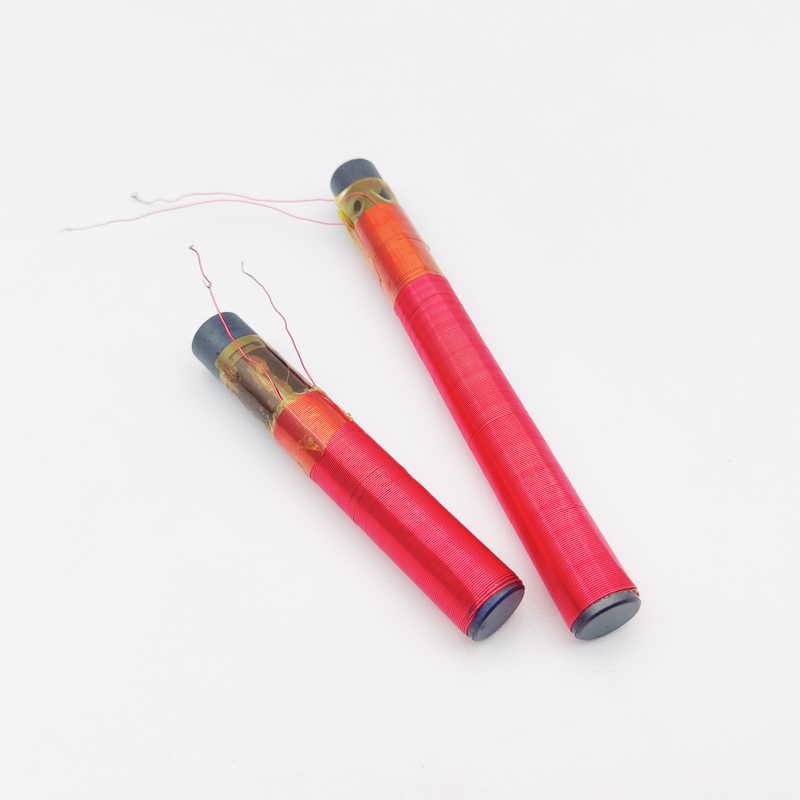
Core losses in a ferrite core coil assembly consist of hysteresis losses, which depend on flux density amplitude, and eddy current losses, which increase with frequency squared. The material grade selection determines the loss coefficient values that predict how much power a ferrite core coil will dissipate as heat during operation, with manufacturers providing Steinmetz equation parameters for each grade. A ferrite core coil operating at 100 kHz with 100 millitesla peak flux density might exhibit core losses ranging from 50 to 500 milliwatts per cubic centimeter depending on whether the designer selected a low-loss power ferrite grade or a general-purpose material. These losses become particularly significant in high-power ferrite core coil applications where inadequate material selection can create thermal runaway conditions, as increased temperature reduces permeability, which increases current requirements, which further increases losses. The ferrite core coil engineer must obtain loss versus frequency curves for candidate materials and calculate expected power dissipation under worst-case operating conditions, including harmonic content from switching waveforms that contribute to additional heating beyond fundamental frequency predictions.
Every ferrite core coil has a maximum flux density beyond which the core material saturates, causing inductance to collapse and potentially creating destructive current surges in power conversion circuits. Different ferrite material grades exhibit saturation flux density values ranging from 300 millitesla for some high-permeability manganese-zinc formulations to 500 millitesla for specialized power ferrite compositions. A ferrite core coil designed with insufficient margin between operating flux density and saturation flux density may function properly under nominal conditions but fail catastrophically during transient events like output short circuits or input voltage surges. The effective cross-sectional area of the ferrite core coil, combined with the number of turns and peak current, determines operating flux density through the relationship where flux density equals permeability times current times turns divided by magnetic path length. Real-world ferrite core coil designs typically target maximum operating flux density between 50 and 70 percent of saturation to accommodate tolerance variations in core geometry, winding accuracy, and current transients while maintaining adequate safety margins.
The ferrite core coil material selection process begins with defining the fundamental application parameters that constrain material choices, including operating frequency range, required inductance value, peak and RMS current levels, ambient temperature range, and allowable power dissipation. A ferrite core coil intended for a 500 kHz boost converter operating at 85 degrees Celsius ambient temperature demands different material properties than a ferrite core coil used in a 5 MHz RF amplifier input matching network operating at room temperature. Engineers should create a requirements matrix that scores candidate ferrite core coil materials against weighted criteria including permeability at operating frequency, core loss at expected flux density, saturation flux density relative to peak current requirements, and temperature coefficient compatibility with the thermal environment. The ferrite core coil selection becomes more complex when applications require operation across wide frequency ranges, such as EMI suppression chokes that must provide impedance from 150 kHz to 30 MHz, where no single ferrite material grade offers optimal performance across the entire spectrum.
Premium ferrite material grades engineered for specific applications often cost two to five times more than general-purpose materials, creating significant cost pressure in high-volume ferrite core coil production scenarios. A ferrite core coil manufacturer must evaluate whether the performance benefits of specialized materials justify increased component costs, considering that superior material properties may enable size reductions that offset raw material expenses through reduced copper usage and smaller form factors. The ferrite core coil design process should include iterative optimization where engineers compare total solution costs between designs using different material grades, accounting for differences in core size, winding complexity, thermal management requirements, and production yield rates. Some applications tolerate the use of lower-cost ferrite core coil materials when designers compensate through larger core dimensions or reduced operating flux density, while other applications with strict size, weight, or efficiency constraints demand premium materials despite higher costs. Real-world ferrite core coil procurement decisions frequently involve qualifying multiple material suppliers to maintain competitive pricing while ensuring consistent performance characteristics across production batches.
Temperature-induced permeability changes in ferrite core coil materials directly impact inductance values, which can shift power supply operating points and reduce efficiency or cause instability. A ferrite core coil experiencing 20 percent inductance reduction at elevated temperature may allow excessive ripple current, increased switching losses, and potential regulation failure. Selecting ferrite core coil materials with temperature coefficients matched to your operating range ensures consistent performance across environmental conditions. Applications requiring tight regulation across wide temperature ranges benefit from ferrite core coil designs using materials specifically formulated for temperature stability, even when these materials sacrifice some permeability or loss performance at room temperature conditions.
A ferrite core coil optimized for one frequency range rarely performs optimally at significantly different frequencies due to fundamental differences in how ferrite materials behave across the frequency spectrum. Ferrite core coil assemblies using high-permeability manganese-zinc materials excel at mid-frequency applications but suffer from excessive losses above 1 MHz, while nickel-zinc ferrite core coil designs perform well at high frequencies but provide insufficient inductance for many low-frequency power applications. Some ferrite core coil designs intended for broadband applications use multi-material cores or accept compromised performance across the frequency range. Engineers attempting to use a single ferrite core coil design across multiple frequency bands should expect reduced efficiency, increased heating, or inadequate filtering performance compared to frequency-optimized designs using appropriate material grades.
Comprehensive ferrite core coil validation requires measuring inductance versus frequency, DC bias characteristics, core loss at operating flux density, and temperature coefficient across the expected operating range. A proper ferrite core coil qualification program includes thermal imaging under full load to identify hot spots indicating excessive core losses, inductance measurements at temperature extremes to verify stability, and saturation testing with overcurrent pulses to confirm adequate margin. Engineers should build prototype ferrite core coil samples using candidate materials and subject them to accelerated life testing at elevated temperatures and electrical stress levels to reveal potential degradation mechanisms. Comparing measured ferrite core coil performance against datasheet predictions helps validate material supplier specifications and ensures production designs will meet reliability targets across manufacturing variations in core composition and geometry.
 Hot News
2026-10-15
2026-10-13
2026-10-08
2026-10-06
2026-10-01
2026-09-21
Zhongshan Landa Technology: ISO9001 & UL-certified manufacturer of custom electromagnets, push-pull solenoids, and induction coils for automation, medical, auto & appliances. Trusted global partner since 2008.
3F, Building 4, No.8 North Industrial Avenue Xiaolan, Xiaolan Town, Zhongshan, Guangdong, China
Copyright © Zhongshan Landa Technology Co., Ltd All Rights Reserved Privacy Policy

 EN
EN